
Metamaterial Antenna Design: Simulation Approaches for Advanced Research
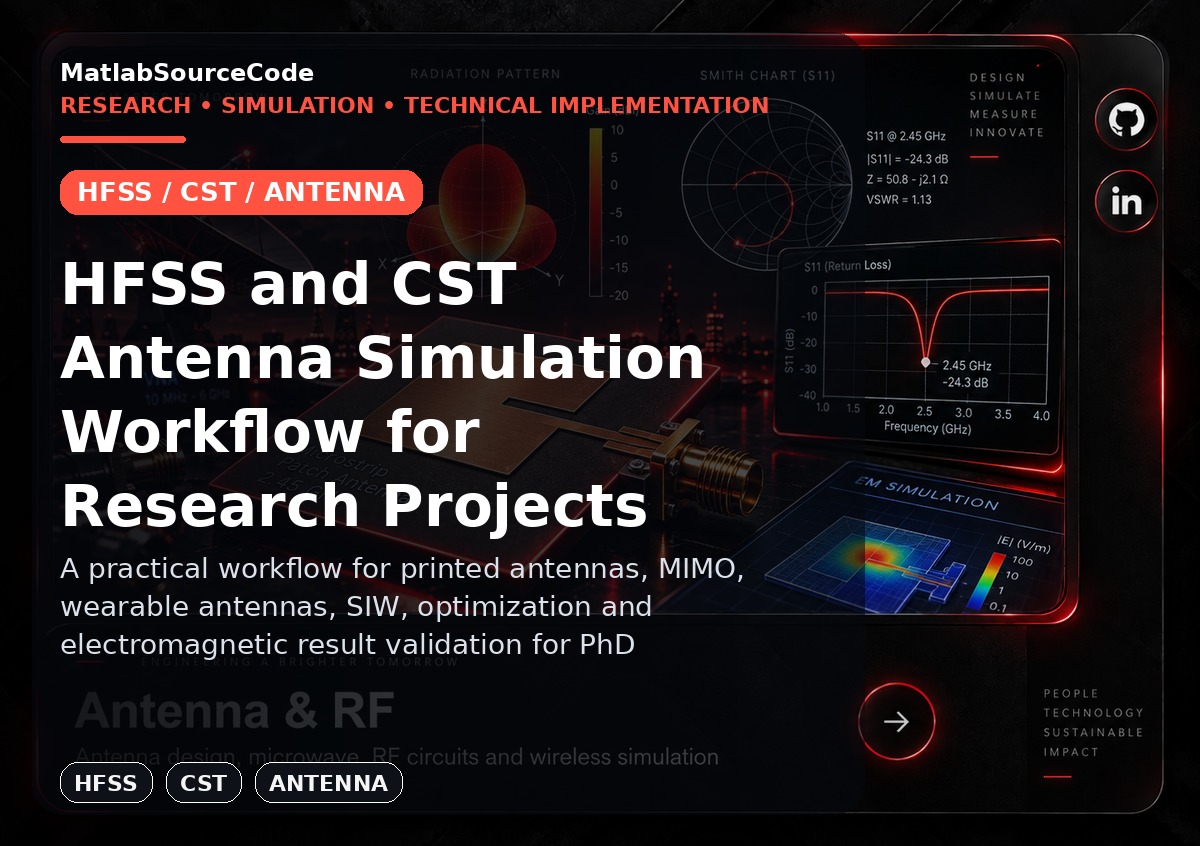
Metamaterial Antenna Design: Simulation Approaches for Advanced Research is most useful as a research topic when the simulation is treated as an experiment rather than a demonstration. The central objective is antenna/RF design workflow from geometry and matching to radiation validation. A strong study fixes the plant and test conditions, defines a baseline, changes one research factor at a time and reports numerical evidence alongside plots.
For doctoral and postgraduate work, the model should make every assumption visible: rated values, data sources, solver settings, controller sampling, initial conditions, boundary conditions and disturbance definitions. This makes the results easier to defend in a thesis, reproduce later and convert into a publication-oriented comparison.
A reproducible modelling and validation plan
- Define target band, substrate/material and size constraints.
- Create first-order geometry from analytical estimates.
- Set ports, boundaries and mesh controls.
- Run frequency sweep and tune matching/resonance.
- Extract S-parameters, fields and radiation patterns.
- Perform parametric/optimisation study and tolerance checks.
What the thesis or paper should measure
Use numerical metrics that map directly to the research objective. Recommended outputs for this topic include:
- S11/return loss
- -10 dB bandwidth
- VSWR
- realized gain
- radiation efficiency
- radiation pattern/ECC when applicable
Move beyond a basic implementation
To turn this topic into a stronger research contribution, start with one baseline and one proposed method, then extend the validation using DGS/metamaterial loading, MIMO isolation, wearable/vehicle platform effects. The final results section should explain why the proposed method changes the engineering behaviour, not only whether the output curve looks smoother. Include failure cases or operating limits when they reveal the boundary of the method.
- DGS/metamaterial loading
- MIMO isolation
- wearable/vehicle platform effects
- multi-band optimisation
Need the model adapted to your research objective?
We can help with model architecture, parameterisation, controller/algorithm implementation, scenario design, plots and research-oriented result interpretation.


