
Solid-State Transformer Modelling: A MATLAB Guide for PhD-Level Research
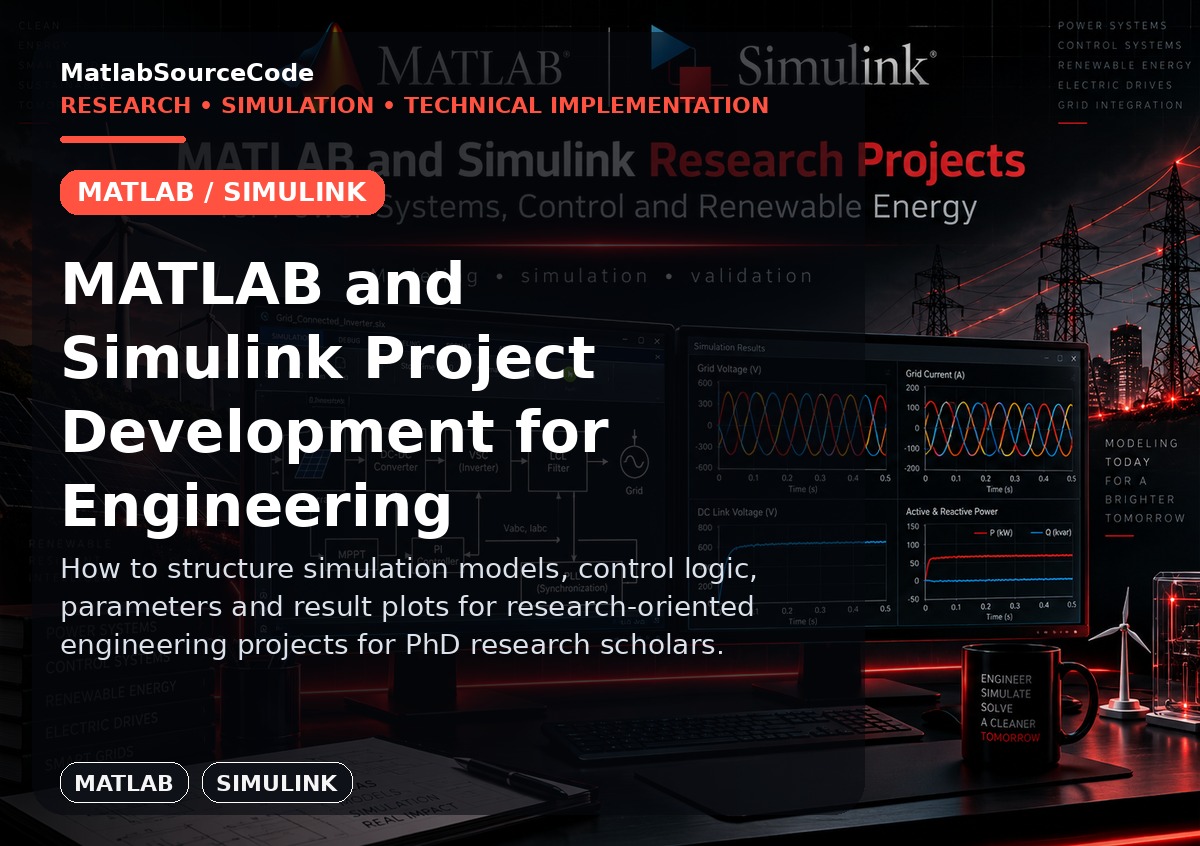
Solid-State Transformer Modelling: A MATLAB Guide for PhD-Level Research is most useful as a research topic when the simulation is treated as an experiment rather than a demonstration. The central objective is multi-stage solid-state transformer conversion with high-frequency isolation. A strong study fixes the plant and test conditions, defines a baseline, changes one research factor at a time and reports numerical evidence alongside plots.
For doctoral and postgraduate work, the model should make every assumption visible: rated values, data sources, solver settings, controller sampling, initial conditions, boundary conditions and disturbance definitions. This makes the results easier to defend in a thesis, reproduce later and convert into a publication-oriented comparison.
A reproducible modelling and validation plan
- Define the medium-voltage AC/DC, isolated DC/DC and low-voltage output stages.
- Select switching frequencies, transformer ratio and DC-link levels from a rated design point.
- Implement modulation and voltage/current control for each conversion stage.
- Add representative grid and load disturbances.
- Record semiconductor stress, power flow and DC-link interactions.
- Compare baseline and optimized switching/control settings.
What the thesis or paper should measure
Use numerical metrics that map directly to the research objective. Recommended outputs for this topic include:
- conversion efficiency
- DC-link ripple
- THD
- transformer flux
- device voltage/current stress
- transient regulation
Move beyond a basic implementation
To turn this topic into a stronger research contribution, start with one baseline and one proposed method, then extend the validation using SiC/GaN device comparison, multiport SST for storage/EVs, soft-switching optimisation. The final results section should explain why the proposed method changes the engineering behaviour, not only whether the output curve looks smoother. Include failure cases or operating limits when they reveal the boundary of the method.
- SiC/GaN device comparison
- multiport SST for storage/EVs
- soft-switching optimisation
- fault-tolerant SST control
Need the model adapted to your research objective?
We can help with model architecture, parameterisation, controller/algorithm implementation, scenario design, plots and research-oriented result interpretation.


