
VDE-AR-N 4105 Compliance in MATLAB/Simulink: What German PhD Researchers Need to Model
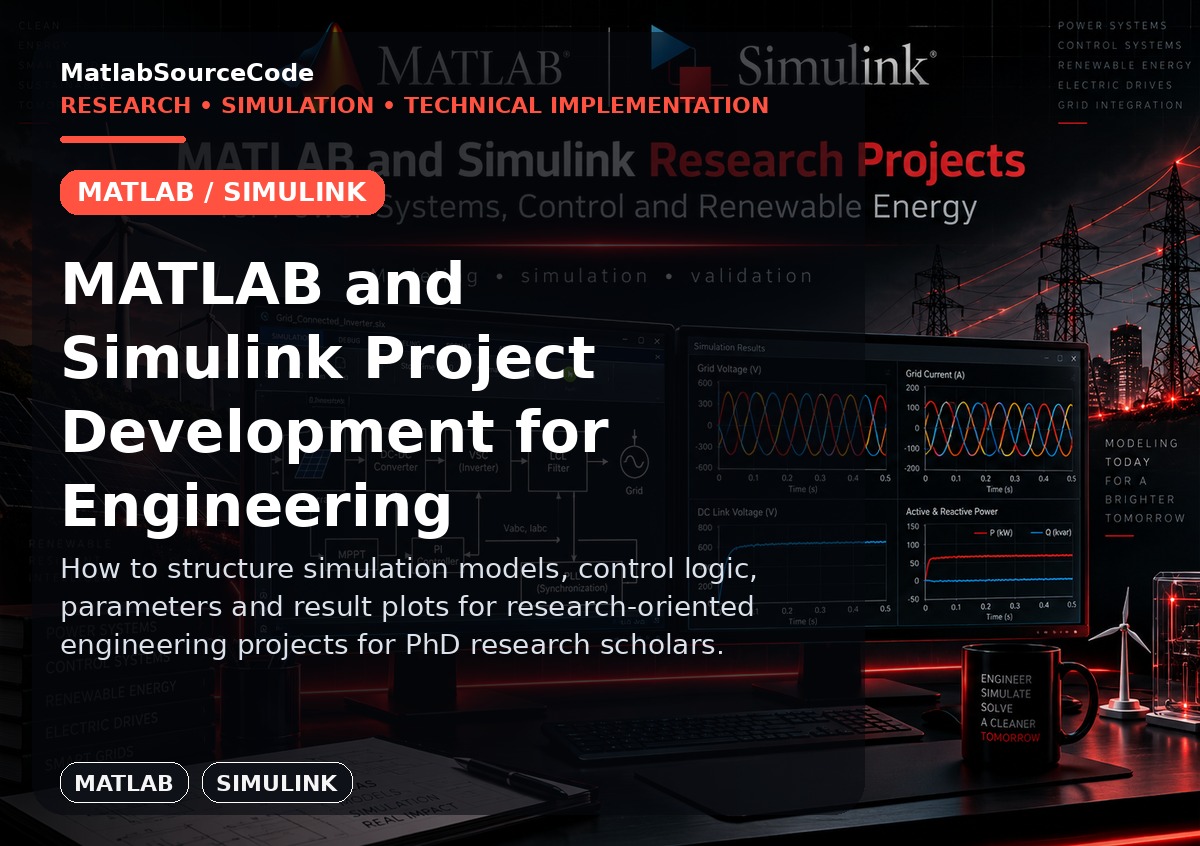
VDE-AR-N 4105 Compliance in MATLAB/Simulink: What German PhD Researchers Need to Model is most useful as a research topic when the simulation is treated as an experiment rather than a demonstration. The central objective is country-relevant engineering simulation with explicit standards, climate, network and research assumptions. A strong study fixes the plant and test conditions, defines a baseline, changes one research factor at a time and reports numerical evidence alongside plots.
For doctoral and postgraduate work, the model should make every assumption visible: rated values, data sources, solver settings, controller sampling, initial conditions, boundary conditions and disturbance definitions. This makes the results easier to defend in a thesis, reproduce later and convert into a publication-oriented comparison.
A reproducible modelling and validation plan
- Define the local technical question, system boundary and regulatory/operating context.
- Select a reproducible benchmark network, plant or energy-system model.
- Parameterise local resource, demand, climate or market data where available.
- Implement the control, planning or compliance test cases.
- Run baseline plus stress/sensitivity scenarios.
- Report numerical metrics and clearly separate model assumptions from local requirements.
What the thesis or paper should measure
Use numerical metrics that map directly to the research objective. Recommended outputs for this topic include:
- voltage/frequency compliance
- energy yield or system cost
- losses/efficiency
- hosting capacity or reliability
- control/transient performance
- sensitivity to local operating conditions
Local standards, operating conditions and research relevance
Germany-focused work can be anchored in the Energiewende, high distributed-PV penetration, electrification of transport and strong grid-code requirements. VDE-AR-N 4105 is a key technical connection rule for generation connected to low-voltage networks; medium- and high-voltage studies require the corresponding VDE rules and network-operator requirements. DFG and federal programmes provide useful context for doctoral research themes in energy, mobility and advanced engineering.
Researchers should verify the latest official standard, network-operator procedure and university/funder requirements before presenting a simulation as a compliance study.
Move beyond a basic implementation
To turn this topic into a stronger research contribution, start with one baseline and one proposed method, then extend the validation using local dataset validation, multi-scenario planning, grid-code compliance automation. The final results section should explain why the proposed method changes the engineering behaviour, not only whether the output curve looks smoother. Include failure cases or operating limits when they reveal the boundary of the method.
- local dataset validation
- multi-scenario planning
- grid-code compliance automation
- techno-economic or resilience extension
Need the model adapted to your research objective?
We can help with model architecture, parameterisation, controller/algorithm implementation, scenario design, plots and research-oriented result interpretation.


