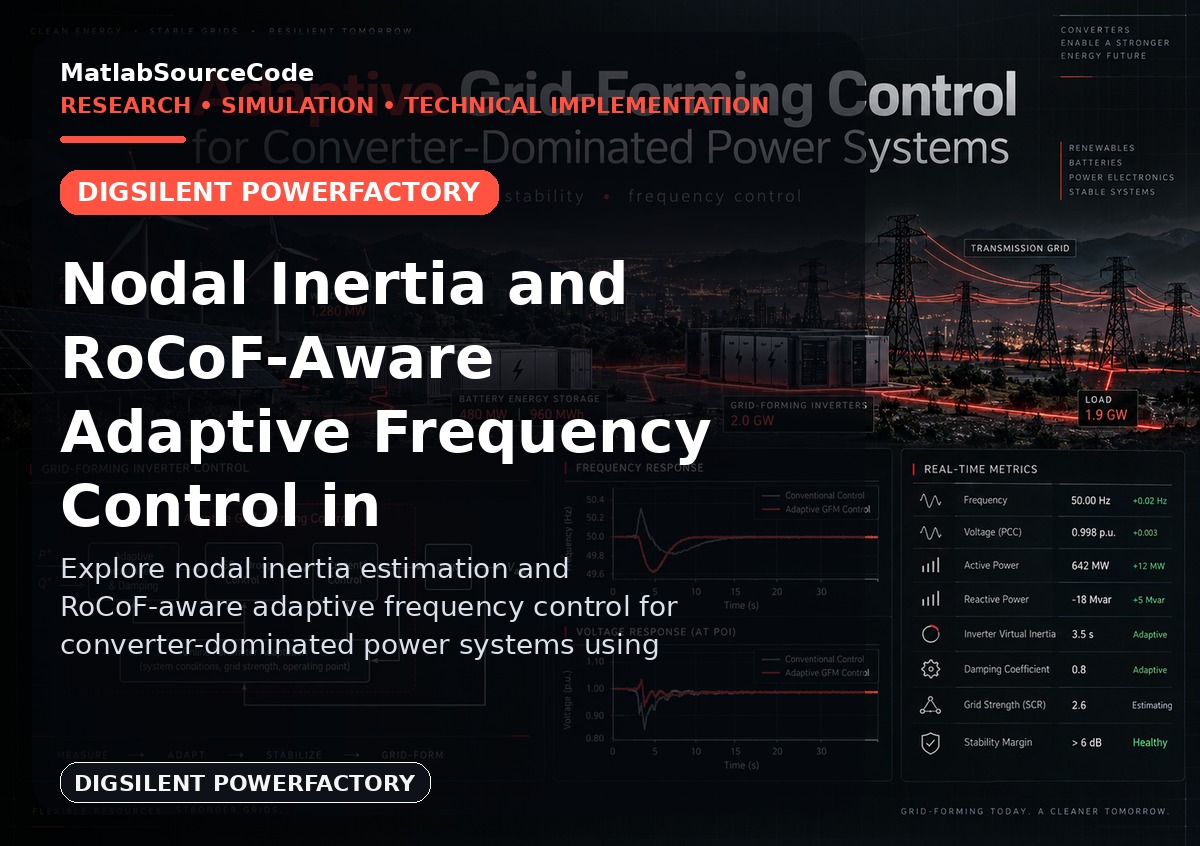
Nodal Inertia and RoCoF-Aware Adaptive Frequency Control in PowerFactory
Power Systems
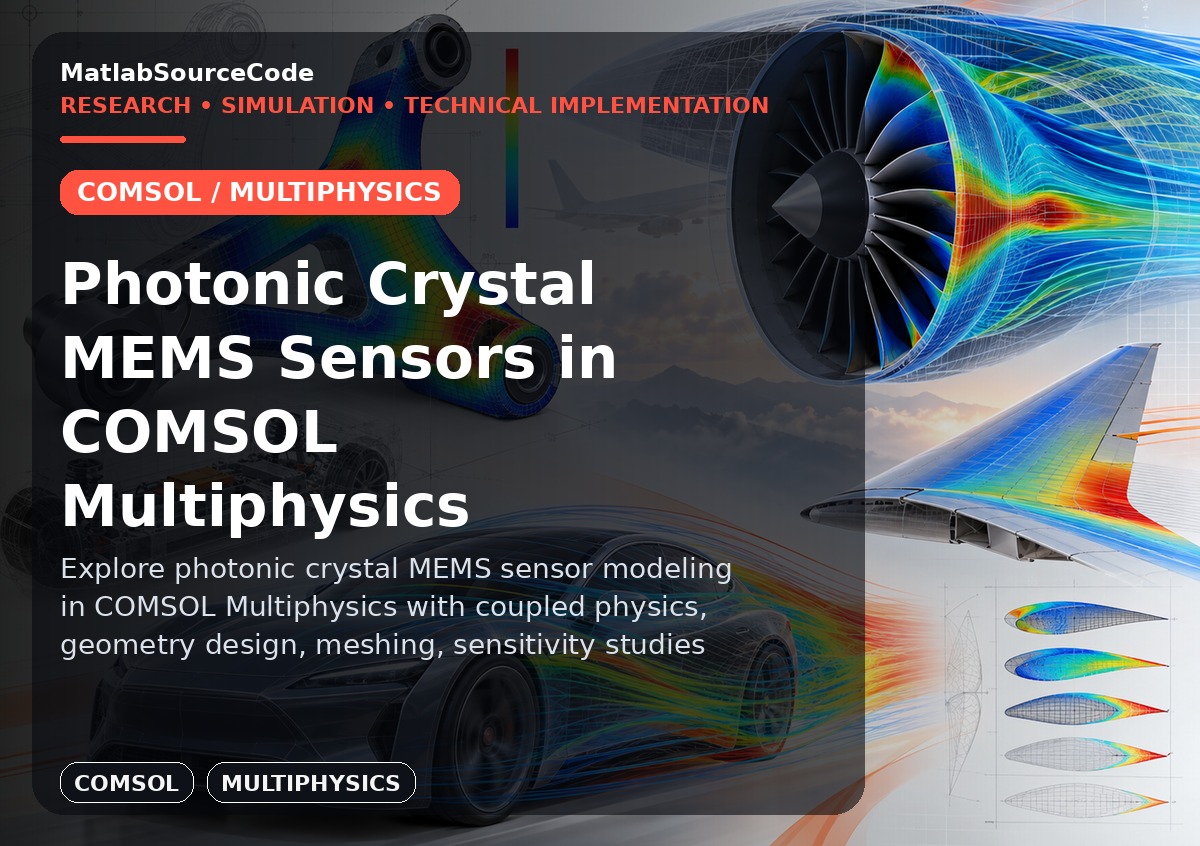
Photonic crystal MEMS combines micro-mechanical deformation with optical resonance. Small structural changes can shift optical response, enabling sensitive pressure, displacement, acceleration or biochemical sensing concepts.
The mechanical model calculates deformation, stress or displacement while the electromagnetic or wave-optics model evaluates resonance or transmission changes.
Research can use cavities, defect waveguides, photonic crystal slabs or mechanically tunable gaps. The geometry should connect a physical stimulus to an optical observable.
A parameter sweep can link load, displacement and refractive-index changes to resonance wavelength, Q-factor, transmission or sensitivity.
Novel cavity topology, enhanced Q-factor, temperature compensation, multi-parameter sensing or MEMS actuation strategies can strengthen the study.
Share your research title, abstract or base paper. The model, controller, case studies and required plots can be scoped around your research objective and software version.

AI & Renewable Energy
Mechanical & CFD
FOC vs DTC for Electric-Vehicle Motor Drives This guide treats FOC vs DTC as an engineering workflow rather than a keyword target. The exact implementation depends on the model, ratings, software release and available source data.
Report only values supported by the actual model, project file, simulation result or cited source. A parameter table should state units and indicate whether a value is measured, selected for the model, or taken from a reference.
Keep labels explicit: simulation result means generated by the actual model; observed result describes what is visible in supplied output; expected result is a technically anticipated trend; example value is illustrative; and paper-reported result belongs to the cited literature.
Depending on the topic, consult the current official documentation from MathWorks, DIgSILENT, ANSYS, COMSOL, IEEE/IET standards, NREL, NIST, AEMO, NESO or ENTSO-E. Use the exact release/standard relevant to the study rather than copying a paper abstract.
For PhD-level extension, define a measurable limitation of the baseline and test one clear improvement—such as robustness, efficiency, stability margin, computational cost, fault tolerance or generalization—against the same validation cases.